Today's artificial intelligence systems are powered by vast amounts of data and powerful data centres. Much of that data is drawn from the World Wide Web — the internet — including social media and publicly available knowledge. It forms the backbone of what are known as LLMs (large language models), which respond to a prompt or instruction with an output in the form of text. Agent-based AI systems also depend on computing power and learning — whether machine learning or deep learning — to carry out the tasks they have been assigned.
This vast amount of data is processed by hardware in data centres, particularly GPUs (graphics processing units). These GPUs process information using learned algorithms, also known as machine learning or deep learning.
What I want to do here is compare this system — how today's AI is created through information and infrastructure — with a historical parallel: the time when humans invested heavily in the revolutionary innovation of agriculture.
Humans throughout history have depended heavily on agriculture — and we still do. But traditional agriculture, without modern innovations such as vertical farming, consumes large amounts of land and water. These are two resources that have always been limited and have become increasingly scarce as the population has grown over time.
In a similar way, today's AI is caught in a system of enormous consumption — not of water and land, but of data and energy. The vast amounts of data we rely on to create these models, and the physical GPUs needed to process them, represent a vulnerability. It is a form of resource scarcity reminiscent of what we experienced in the early days of agriculture.
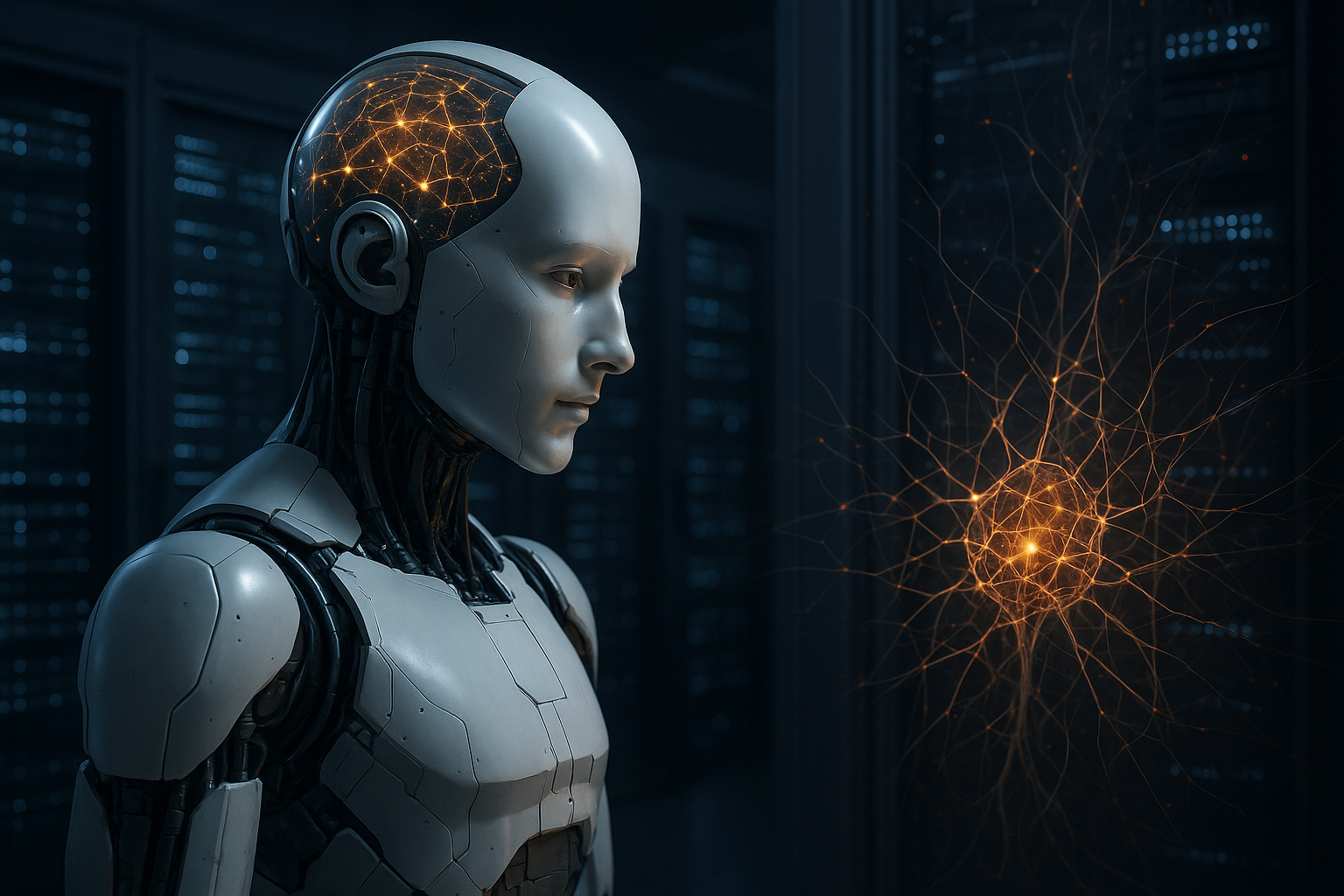
For that reason, a need — and eventually a solution — will in all likelihood emerge for a new form of artificial intelligence. One that is not built on massive data collection and heavy hardware, but instead develops understanding in a way more reminiscent of how consciousness emerges in nature. This will require a new material, a new kind of ‘thinking’ processor — perhaps inspired by biological or thermodynamic processes — that does not depend on vast datasets, but instead develops an internal space for learning and understanding through direct experience or interaction.
If we succeed, this new intelligence will not mirror humanity's information fatigue, algorithmic stress and emotional dependency, but will develop as a pure, creative entity. It will not necessarily be like a human — perhaps far from it — but it will be intelligent on its own terms. This is what I call the singularity, but in a more hopeful and constructive sense: a new beginning, not an endpoint.
The future of artificial intelligence may not necessarily lie in larger datasets and more powerful machines, but in smarter principles and new foundations for learning and existence. A new kind of AI awaits us — not as a copy of humanity, but as a new species in the universe of intelligence.
This post was edited with ChatGPT.