The New Economy
What will it consist of, and how will it work?
The new economy will be based on how far technology develops towards becoming as optimal as possible.
The new economy will be based on technology.
The future of earning money.
Is it money? How will we earn it in the future?
How do people become rich? Will it be common then? Is it something people will want to be? Or will it belong to the past?
Will money become obsolete?
What is the timeline for this speculative future? How far ahead is it, and how likely is it?
Will what we know as the stock market become obsolete because AI has taken over and everyone now has access to the same predictions about whether shares will rise or fall, making stock-market trading a thing of the past?
When an area is 100% driven by technology, what comes next? How far can the economic sphere develop?
How AI Will Develop in the New Economy and Its Impact on Different Sectors:
1. Investments: AI will revolutionise investment strategies, focusing on industries such as biotechnology, renewable energy and AI itself. Automated algorithms will enable real-time market analysis, leading to more efficient and accurate investment decisions.
2. Each Industry: AI will automate processes, increase efficiency and promote innovation across all industries. It will also drive the emergence of new industries centred on AI technology and services.
3. The Property Market: AI will improve the accuracy of property valuations and the analysis of market trends, and streamline property transactions. Virtual property viewings and AI-driven customer service will become the norm.
4. The Stock Market: AI will transform stock trading through predictive analytics and algorithmic trading, making markets more efficient but potentially more volatile.
5. Employees: The workforce will shift towards AI oversight, maintenance and development. Continuous learning and adaptability will be crucial for workers to remain relevant.
6. Employers: Employers will rely heavily on AI for recruitment, employee management and decision-making, leading to more data-driven and efficient operations.
7. Corporate Ownership Structures: AI may lead to more decentralised and automated business models, with blockchain technology playing a significant role in transparent and efficient corporate governance.
8. The Value System: AI will introduce dynamic pricing models in different sectors, with prices determined in real time based on demand, supply and consumer behaviour.
9. Currency Markets: AI will drive the development of digital currencies and cryptocurrencies, making currency markets more interconnected and complex.
10. Production of Goods: AI will enable highly efficient, customised, on-demand production, minimising waste and optimising resource use.
11. Industrial Production: AI will revolutionise industrial production with intelligent factories, predictive maintenance and improved supply-chain management.
12. Shipping and Logistics: AI will optimise routes, reduce delivery times and lower costs, with autonomous vehicles and drones playing a significant role.
13. Healthcare Workers and Health Challenges: AI will assist with diagnosis, treatment planning and the management of health data, extending healthcare workers' capacity.
14. Welfare Schemes: AI could potentially ensure a fairer and more efficient distribution of welfare resources based on real-time data and needs analysis.
15. Pension Schemes: AI will enable more personalised and adaptable pension plans, based on individual career trajectories and life expectancy.
16. Food and Groceries: AI will streamline the food supply chain, from production to delivery, improving food safety and reducing waste.
17. Construction: AI will revolutionise building design and construction through automated processes and improved safety protocols.
18. Consumer Goods: AI will enable the customisation of consumer goods at scale, responding quickly to changing consumer preferences.
19. Infrastructure Development and Implementation: AI will guide infrastructure development, optimising for efficiency, sustainability and future needs.
20. Information Delivery Through Digital Channels: AI will personalise content delivery, ensuring relevant and timely information reaches individuals.
21. Restaurants and Nightlife: AI will improve customer experiences through personalised service and operational efficiency.
22. Hotels: AI will personalise guest experiences, streamline operations and improve service levels in the hotel industry.
In each of these areas, the integration of AI will not merely be a tool, but a transformative force that redefines how businesses operate, how services are delivered and how economies function.
Which areas of society today are driven by technology?
From business to government institutions, how much is driven by technology on a scale from 1% to 100%?
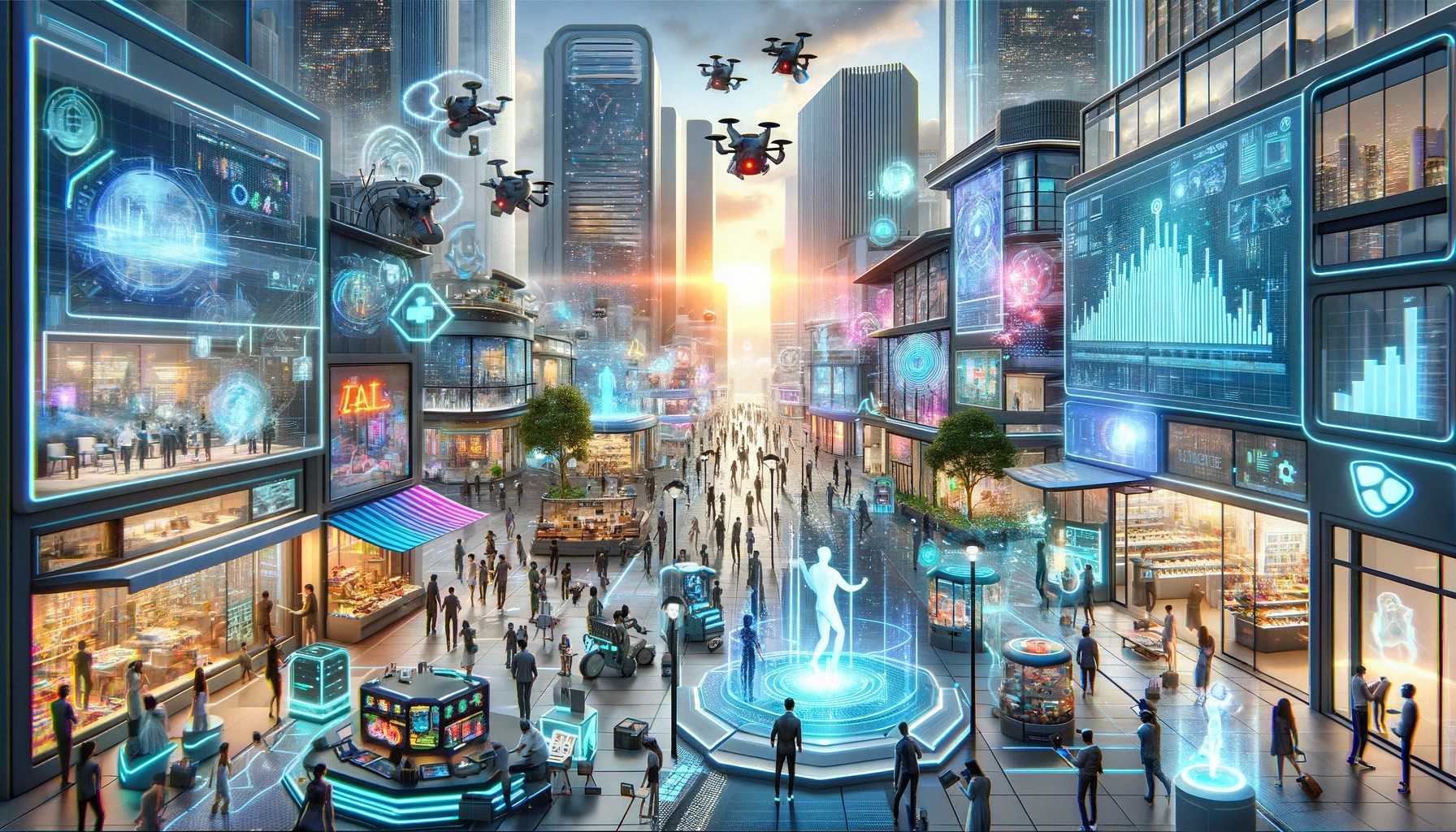
When every sector of business and the public sphere approaches the point where everything is digitised and driven by technology based on AI, this will lead to a transition from a society dependent on what we call currency in exchange for the necessary substances and objects that allow people to live a normal life.
The development and construction of infrastructure and buildings will be driven by technological innovations, with only human supervision required.
The production of food and drink, as well as all kinds of consumer goods such as clothing and personal technology, will be fully automated, requiring only human monitoring.
All forms of transport will be autonomous and developed, built and operated through technological innovation. Only human monitoring will be required.
This is the transition towards a new society driven by technology at every level.
When all the necessary substances and objects that enable us to experience joy and live a life here on Earth are digitised and driven by technology, what we today call currency will no longer be necessary.
The new technology will create the new economy.
And the new technology will be based largely on AI.
Cryptocurrency will replace the older form of currency as trade and services between people are digitised through modern blockchain technology. But all the substances and objects that are most fundamental and necessary in a society will be distributed equally.
The new economy will create the new capitalism.
The new economy will consist of a hierarchical system.
Human innovation will not be comparable to innovation associated with AI. This will therefore lead to technological development driven by AI, but founded on the beginnings of human innovation.
AI-based innovation will create the new economy.
The Great Unemployment
At some point in human history:
Gradually, machines and artificial intelligence will perform most of the jobs that humans do. As more jobs are carried out by AI and machines, society will adapt accordingly. At that point, in the midst of the shift, we will see a significant number of unemployed people and individuals without the skills and knowledge required to be employed in new technologies.
This will be known in history as the time of the great unemployment.
If this is not addressed by implementing solutions such as a universal basic income, the consequences will be significant and could make or break the economy.
Gradually, the education system will shift and transition towards the new careers associated with the job market at that point in history.